Contact Your USDA Mortgage Loan Specialist: Local (717) 306-7144 | Toll Free (866) 747-2882

USDA Home Loans in Pennsylvania
Buy a Home in Pennsylvania with $0 Down
Pennsylvania USDA Loans: Household Income and Qualifying Income Matter
What Are Pennsylvania USDA Loan Income Requirements?
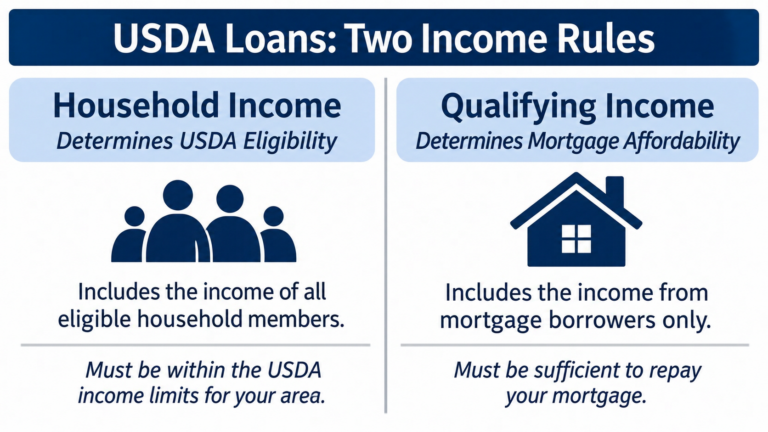
USDA home loans have two separate income requirements. First, the household must meet USDA’s income limits for the area where the property is located. Second, the borrowers must demonstrate sufficient qualifying income to afford the mortgage payments.
These are two different calculations. A household may earn too much to qualify for USDA financing even though the borrowers can comfortably afford the mortgage. Conversely, a household may fall below USDA’s income limit but not have sufficient qualifying income to obtain loan approval.
Understanding the difference between household income and qualifying income is essential when applying for a Pennsylvania USDA loan.
What Is USDA Household Income?
USDA household income generally includes eligible income received by all adult household members, regardless of whether they are applying for the mortgage.
For example, suppose a married couple is purchasing a home and their 25-year-old employed son will continue living with them. Even if the son is not listed on the mortgage application, his eligible income generally must be included when determining whether the household meets USDA’s income limits.
USDA calculates annual household income based on anticipated eligible income for the upcoming 12 months. This may include wages, overtime, bonuses, commissions, self-employment income, retirement benefits, and other applicable sources.
Certain income exclusions and special rules apply, including limitations on how much earned income from qualifying adult full-time students is counted.
What Is Adjusted Annual Household Income?
USDA allows certain deductions from annual household income to determine whether the household meets the program’s income eligibility limits.
Examples of allowable deductions include:
$500 for each qualifying dependent.
$550 for an eligible elderly household.
Qualifying childcare expenses.
Certain eligible disability-related and medical expenses.
Not every household qualifies for every deduction. The lender must verify the applicable expenses and determine the adjusted annual income.
The resulting amount is compared with the USDA income limit for the county or area where the property is located.
What Is USDA Qualifying or Repayment Income?
Qualifying income, referred to by USDA as repayment income, is the income used to determine whether the borrowers can afford the mortgage.
Unlike household income, repayment income generally includes only eligible income from borrowers who will be obligated on the mortgage note.
The lender evaluates employment history, income stability, documentation, and the likelihood that the income will continue. Income used to qualify must generally be expected to continue for at least three years.
For example, an adult child living in the home may earn $40,000 annually. That income may count toward the household income limit, but it cannot be used to help the parents qualify for the mortgage unless the child is also an eligible borrower on the loan.
USDA Household Income vs. Qualifying Income
| Income Category | Household Income | Qualifying Income |
|---|---|---|
| Primary purpose | Determines USDA program eligibility | Determines ability to repay |
| Whose income counts? | Eligible income of adult household members | Eligible income of borrowers on the mortgage |
| Income calculation | Projected annual income, less allowable deductions for eligibility | Stable, dependable monthly income |
| Non-borrowing adult income | Generally included | Not included |
| Income limits | Subject to USDA county/area limits | Evaluated against mortgage payment and debt obligations |
| Employment and income history | Used to project household income | Used to establish qualifying income stability |
Real-Life Example: How Overtime Income Can Make a Household Ineligible for a USDA Loan
Can Overtime Income Cause You to Exceed USDA Household Income Limits?
Yes. Overtime income that cannot be used to qualify for a USDA mortgage may still count toward the household income limit.
Consider a married couple purchasing a home in Pennsylvania. The husband recently started a new job and has been employed for only six months. Although he regularly works overtime, he has no prior overtime history in the same or a similar line of work.
His overtime does not meet USDA’s required history for repayment income. However, because his employer verifies that the overtime is expected to continue, the projected overtime earnings must be included in the household income calculation.
For this example, assume the USDA household income limit is $120,000 annually.
| Income Source | USDA Household Income | USDA Qualifying Income |
|---|---|---|
| Husband’s base salary | $65,000 | $65,000 |
| Husband’s projected overtime | $18,000 | $0 |
| Wife’s base salary | $45,000 | $45,000 |
| Total Annual Income | $128,000 | $110,000 |
The Result
The couple has $110,000 in qualifying repayment income, which may be sufficient to afford the proposed mortgage payment.
However, their projected annual household income is $128,000, exceeding the hypothetical USDA income limit of $120,000 by $8,000.
Assuming no applicable household income deductions, the couple would be ineligible for USDA financing, even though the lender cannot use the husband’s overtime to help qualify for the mortgage.
This example illustrates an important distinction: USDA may count income against you when determining program eligibility even when that same income cannot be used to help you qualify for the loan.
Note: This example assumes the husband has no qualifying prior overtime history. A new job alone does not automatically disqualify overtime from repayment income if acceptable prior history exists.
How Much Household Income Can You Earn and Still Qualify for a Pennsylvania USDA Loan?
USDA household income limits vary depending on the county or metropolitan area where the property is located and the number of people in the household. To find the income limit for the county where you plan to purchase a home, visit our Pennsylvania USDA Income Limits by County page. The county-specific limits can help you determine whether your household may qualify for USDA financing.
The program generally provides one income limit for households of one to four people and a higher limit for households of five to eight people, with additional adjustments for larger households.
USDA updates these limits periodically, so homebuyers should always check the current figures rather than relying on outdated income charts.
You can review current income limits using the official USDA Income Eligibility Calculator.
Can You Qualify for a USDA Loan With Overtime, Bonuses, or Commission Income?
Yes. Overtime, bonuses, commissions, and other variable income may be considered when qualifying for a USDA loan.
However, the amount counted toward household income may differ from the amount the lender can use as repayment income.
For example, overtime expected to continue during the next 12 months may be included in household income. However, the lender must separately establish that the overtime meets USDA’s history, stability, and continuance requirements before using it to qualify for the mortgage.
This distinction can be especially important for borrowers whose income fluctuates throughout the year.
Frequently Asked Questions About USDA Income Requirements
Does Everyone Living in the Home Have Their Income Counted?
Generally, eligible income from all adult household members must be considered for USDA income eligibility, even if they are not applying for the mortgage. Special exclusions and limitations may apply.
Can a Non-Borrowing Spouse’s Income Affect USDA Eligibility?
Yes. A spouse’s eligible income generally counts toward household income even when the spouse is not a borrower on the mortgage.
Does USDA Use Gross or Net Income?
For wage earners, USDA generally uses gross income before taxes and payroll deductions. Self-employment income and certain other income sources require different calculations under USDA guidelines.
Can You Qualify if Your Household Income Is Close to the USDA Limit?
Possibly. USDA allows certain household income deductions that may reduce adjusted annual income below the applicable limit.
Does USDA Have a Minimum Income Requirement?
USDA does not establish one universal minimum salary. Borrowers must demonstrate sufficient stable and dependable repayment income to support the proposed mortgage payment and other financial obligations.
Find Out Whether Your Household Qualifies for a Pennsylvania USDA Loan
Determining USDA income eligibility involves more than comparing your salary to a published income limit.
At Millennial Home Loans, we can evaluate your household income, qualifying income, and applicable USDA deductions to help determine whether you may qualify for a zero-down-payment mortgage.
For additional information about Pennsylvania USDA home loans, contact Millennial Home Loans at (866) 747-2882.